Raquette Lake | William West Durant | Great Camps | Clergy | Time Line | Writings | Documents | Bibliography
CLERGY (1880 – Present)
1880 – 1885 THROOP FAMILY
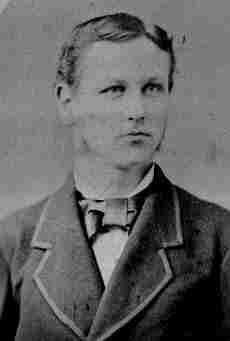
The Rev. Montgomery Hunt Throop II b. 1856, at age 24 was the first minister of the little chapel and in 1881 organized the Mission of the Transfiguration in Blue Mountain Lake. Both churches were consecrated by William Croswell Doane, first Episcopal Bishop of Albany and son of Bishop George Washington Doane of New Jersey.
Bishop W.C. Doane was the author of the hymn, Ancient of Days, organizer and founder of the Cathedral of All Saints, St. Agnes School for Girls (now Doane Stuart) and Child’s Hospital, all in Albany.
The Rev. Throop II, whose great-uncle was governor of New York state from 1829-1832, was married in September 1884 to Agnes Campbell of St. Andrew’s Episcopal in Harlem. In 1887 he served as assistant to St. Michael’s and in 1888 Church of the Advent, both in Harlem, and from 1893 – 1897 as rector of St. Matthew’s in Jersey City, New Jersey. In 1900 he ran for the democratic nomination to Congress.
During WWI his son, Montgomery Hunt Throop III and his wife Elizabeth Nichols, left for Shanghai, China, as missionaries under the Episcopal Missions where their son, Montgomery H. Throop IV (1918-2004), was born. In 1922 Rev. Throop III undertook the first Protestant translation of the Apocrypha into classical Chinese.
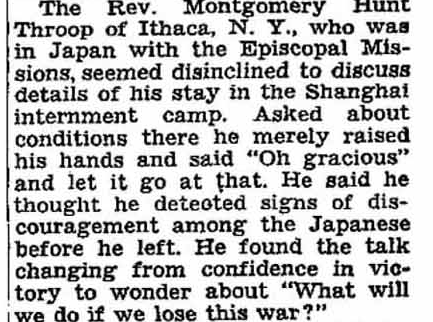
Unfortunately with the entrance of America into WWII during which his son was a decorated fighter pilot, Mr. Throop III was swept up with thousands of expatriates living in China, Japan and the Philippines. He spent six months to two years interned in a Shanghai prison camp, returning to the United States in 1943 aboard the Swedish liner, the Gripsholm.
From the New York Times 3 December 1943
In 2001 and again for the 125th anniversary in 2005, we were delighted to welcome the three great- great-grandsons of Montgomery H. Throop II to the Annual Service with their families. They have owned property on Pine Island on Raquette Lake since the 1950s but were unaware of Mr. Throop’s connection to St. Hubert’s.
1886 – 1894 VARIOUS CLERGY
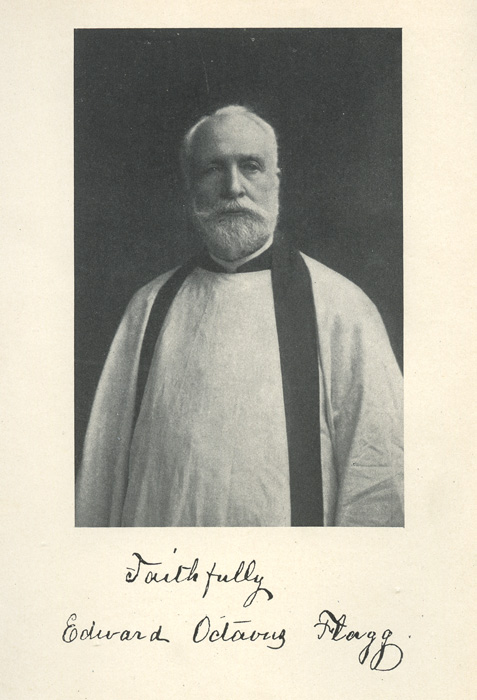
In 1889 one of several priests who served Raquette Lake during these nine summers was the Rev. Edward Octavus Flagg DD, rector of Grace Church (Episcopal) in New York City. His love for the area is amply illustrated in two poems, “St. Hubert’s Isle No.1” and “St. Hubert’s Isle No. 2,” published in Earlier and Later Poems (1890, 1895, 1906 and 1910).
Mr. Flagg was born 13 December 1824 in Georgetown, South Carolina. He married Mary Letitia Ferris, born about 1839, daughter of a Connecticut lawyer who went on to become a state senator. They settled in New York where they had three daughters.
1895 – 1941 BROWN-SERMAN FAMILY
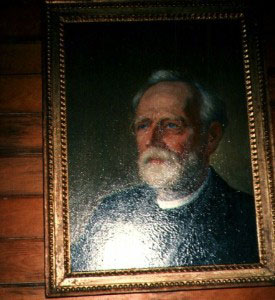 William Brown-Serman (1854-1950) was born in Upton on Severn, Worcestershire, England, where he became a member of the clergy of the Pilgrim Brethren Church. Both his parents died when he was young and he was raised by an aunt, whose name Serman he added to his own. In 1889, when his son Stanley was six years old and Muriel 12, the family immigrated to Canada and at that time the name became hyphenated. William was ordained a priest of the Anglican Church 24 May 1891 and was assigned a church in Marquette, Michigan, where the family lived in a sod house, much to the dismay of his wife, the former Elizabeth Walker.
RAQUETTE LAKE
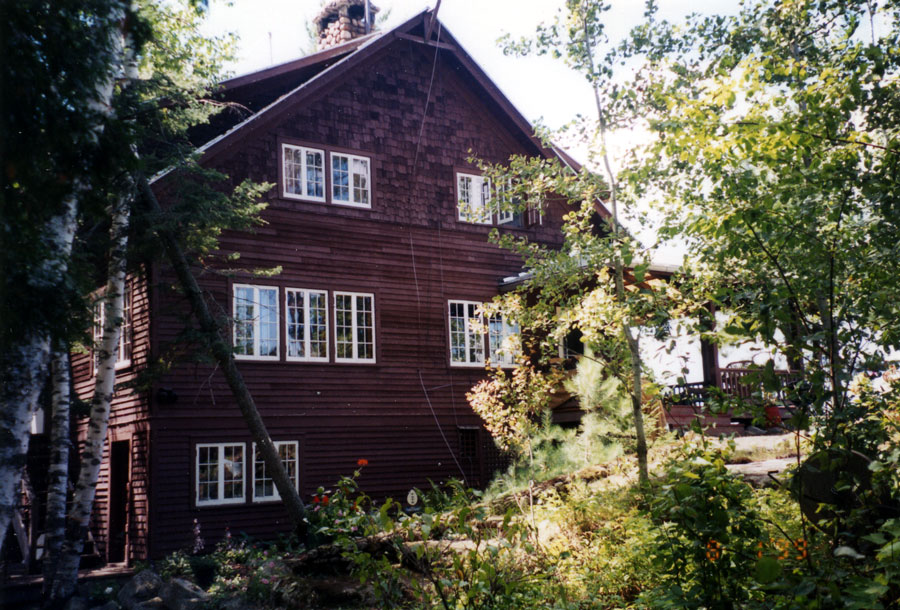
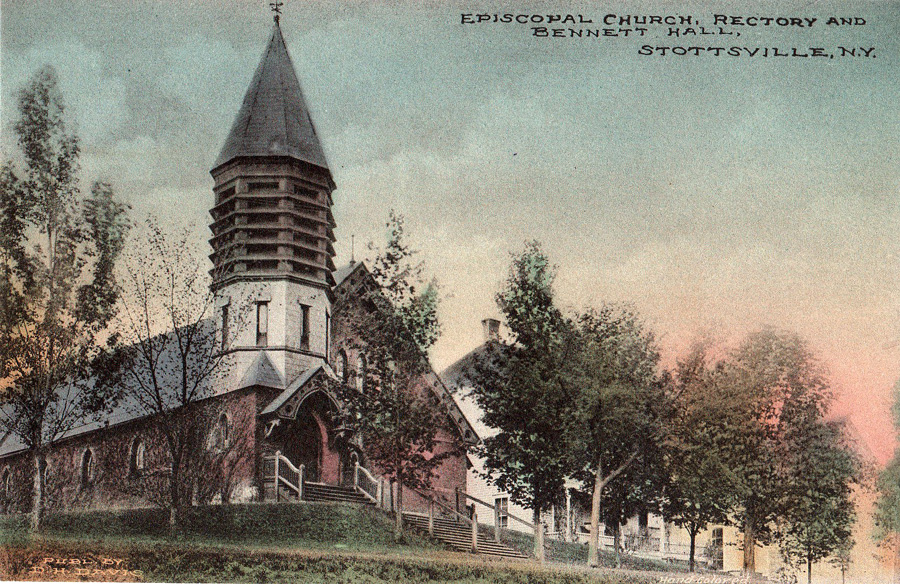
On 1 December 1894 William was appointed priest-in-charge of both St. Barnabas’ Church in Stottville, New York, and the Church of the Good Shepherd in Raquette Lake. The Stotts were members of both congregations, and contributed financially to the construction of the island church in 1880. In 1876, Francis Stott, at the urging of his friend William West Durant, built a great camp on Bluff Point on Raquette Lake (sold to the Collier family in 1905).
 |
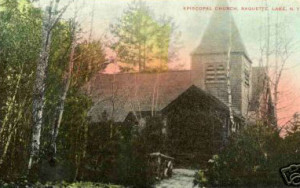 |
1911 St. Barnabas, Stottville and 1913 Good Shepherd, Raquette Lake
Before the rectory was built in 1882, visiting clergy stayed at Camp Stott or at Fairview on Osprey Island. For over 20 years, from 1880 to 1900, the Stott women took charge of the little church, cleaning the buildings and planting the gardens each spring, often during the worst of the black fly season. In all likelihood, this contact with the Stotts at St. Barnabas led to William Brown-Serman staying at Raquette Lake for 47 summers.
FIRE
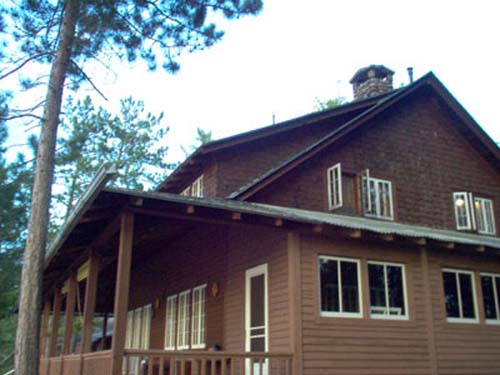
In 1914 the rectory and all the church records were destroyed by fire. William barely managed to get his wife Elizabeth down from the second floor in time using an outside stairway at the rear, although it too was made from wood. A rough cottage was built between the church and the empty site in 1917 while their son Stanley designed a new rectory, constructed in 1918. It was all his own design save some professional help with the stairway.
A pasteboard of a pyramid of building blocks was set up in the church vestibule and each member of the congregation could purchase a block. About one-quarter of the cost of the new structure was funded in this manner with Stanley’s father, William, absorbing the balance.
A huge fire in 1922 on neighboring Osprey Island destroyed Fairview, built by Ed Bennett for Charles Durant in 1879 (later sold to J Harvey Ladew of NYC in 1891). Stanley climbed out on the porch roof of the new rectory and covered it with wet bed sheets to catch the large chunks of burning material that were flying across the channel.
WEDDING
In the 1920’s Asygell (a-SY-jell) Carrington married William’s daughter, Muriel, on St. Hubert’s Isle in a beautiful ceremony for which a bounty of fresh flowers, including lilies, were delivered by train direct to the Raquette Lake Station from New York City. Asygell then assisted his father-in-law with the summertime church services .
1931 – 1941
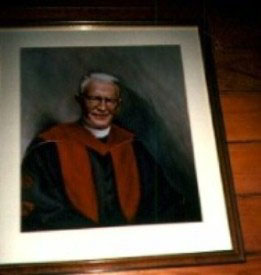
In 1931 Stanley Brown-Serman (1883-1955), a graduate of the Virginia Theological Seminary, joined his father in holding services, later taking full charge. In 1933 William was the priest in Dobbs Ferry, NY. Stanley and his wife Marion had three children, Mary, Elizabeth “Betty” (1919 – 2012) and Arthur.
Stanley’s daughter, Mary Brown-Serman Walke Kirby (1917 – 2010), remembers her first visit to St. Hubert’s the summer of 1927 when she was 10 years old.
CHURCH FATE
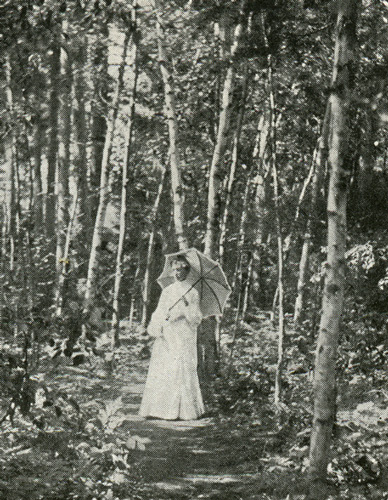
“A church fair was in progress – decorated booths were everywhere, some with fancy work [crocheted and embroidered items] and all the ladies in gorgeous hats and long chiffon afternoon dresses. The fair was held down in the flat opening along the path leading from the gazebo up towards the church. There was lemonade, cookies and a white elephant table [used items]. I was not otherwise at the Lake until 1931 when we started coming regularly.”
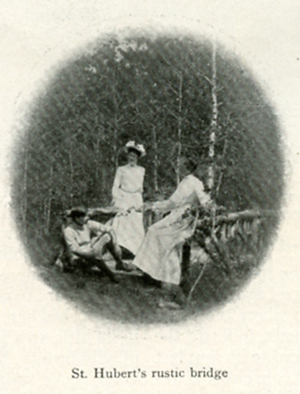
ST. HUBERT’S BRIDGES
“I remember three bridges. The one I remember a picture of was from near the boat house to the peninsula we called Blueberry Island. This is the one either I or my mother painted a little watercolor of that is in the house, near the living room fireplace, or it was. There was another bridge over a dip in the path [leading from the church steps], not very photographic. There was a wooden set of steps from the mail dock [now on the bottom of the lake] up to the top of the rock near the gazebo.”
BOATS
“From 1927 I remember steam launches, Chris-Crafts (from the Evans, Echo and Carnegie camps probably) and small boats bringing people to church, but cannot really distinguish between 1920s and 30s. The big dock in the cove by the boat house was never there until your father [Ralph Carmichael] had it built [by Fred Burke]. We had only boat slips. But there was a path around from the mail rock [near the gazebo] to the boat house and one from the boat house up to the church leading off the one to the rectory.”
[Phone conversation with webmaster on 9 July 1998 and e-mail on 28 July 2004]
In November 1943 Mary’s brother Arthur Stanley Brown-Serman lost his life at age 20 training for WWII, his name inscribed on the wall of Harvard Memorial Chapel, Class of 1944. He was a Marine stationed in San Diego and is buried in Arlington Cemetery, Virginia. Also in 1942 their father’s teaching schedule at Virginia Theological Seminary changed to 12 months a year due to the war and, sadly, the family had to end their long association with Good Shepherd.
1942 – 1958 (No Services)
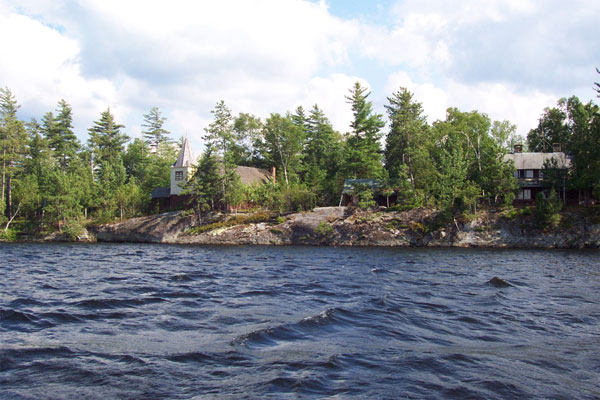
From 1946 through 1953, the Island was a favorite vacation home for Bishop Frederick Barry of Albany. But the great storm of November 1950 took down about 60 trees and St. Hubert’s lay idle from 1953 until 1959. (Another 70 trees came down during the microburst of 1986, and 27 more in 1995.) Bishop Barry’s brother-in-law was the caretaker for St. Hubert’s during this period, but the damage caused in 1950 was just too much for one person. All the paths were blocked by huge tree trunks, the ice house and tool shed were badly damaged and a tree had fallen against the roof of the east bedroom causing a leak. Fortunately the church was not damaged. Bishop Barry did not return after 1953.
1959 – 1995 CARMICHAEL FAMILY
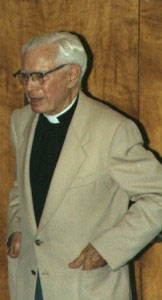
In 1960 the Diocese of Albany sold St. Hubert’s to the Rev. Ralph M. Carmichael (1912-1995) who, with his wife Jean, used it as their summer and then permanent residence. Ralph and Jean set to work cleaning up the property, cutting up logs, tearing down the ice house and tool shed, later modernizing the Guest House in 1973. Except for some leaks in the ceiling, the church did not need any structural work until 1968 and again in 2002 when the foundation was rebuilt, each time using the original stones. The latter work was done by Mr. Stone, a stonemason from Plattsburgh, assisted by Ralph’s grandson Matt.
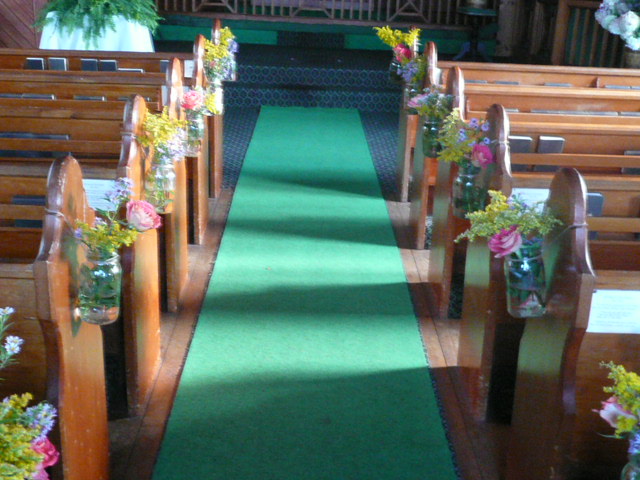
In 1967 and 1968 Boy Scout Troop 400 from Syracuse under Jack Ekland repaired the leaking roof. In 1979 the brick chimney was rebuilt by Fred Burke. In 1980 Troop 400 painted the outside of the church, using the color scheme of brown stain and cream paint taken from early photographs found in the study. The indoor-outdoor carpeting was a gift from Helen Stewart in 1980. Troop 2 from Albany has visited several times over the years, helping to clear paths.
In 1969 the church was rededicated by Bishop Barry of Albany. He stated that his opinion of 1960s young people had been dramatically reversed after viewing the repairs made by the Scouts and observing the participation of the Echo Camp Girls’ Choir in the service.
ADIRONDACK HERITAGE
Ralph and Jean loved Raquette Lake and had a keen interest in the history of the area and of St. Hubert’s. Their guests included Harold K. Hochschild, William Wessels, the two Brown-Serman granddaughters, Craig Gilborn, Ruth Timm, Warder Cadbury, Howard Kirschenbaum of AARCH and others concerned with preserving the property as an historic place of Adirondack heritage.
Just the week before he died, Ralph was filmed by A&E for a video on America’s Castles. The footage was cut, but later released as Part I of Adirondack Great Camps: Durant and Raquette Lake.
ELECTRICITY
The church has never had electricity, but the Carmichaels decided to stop the use of kerosene lamps on the island due to all the grandchildren who were not familiar with the danger from fire. In the 1960s four of the five islands, Strawberry, Osprey, Little Osprey and St. Hubert’s (Wee Two was added later) joined together to have a telephone line and then electricity brought over in an underwater cable from the Antlers.
TELEPHONE
For many years we had a party line with Strawberry, had to call “central” for any call not within Raquette Lake and only had to dial four digits for local calls – all this while the rest of the country already had touchtone service!
When we requested a second phone line in 1996 the installer said we already had two – one dating from the 1940s. This was so amusing, remembering the signals my parents had concocted from 1959 through 1965. Guests would drive to the Antlers dock and honk for my father to come and pick them up in our boat. When there was a telephone message on shore, Don Langham would raise a white flag on one of the dock pilings. Then Dad would paddle over in our old Grumman canoe to use the phone at the Antlers Casino.
SERVICES RESUME
For 39 summers, Ralph served the Church of the Transfiguration in Blue Mountain Lake (1957-1995). He was appointed priest-in-charge in 1959. After retiring from St. Andrew’s Albany (1955-1975) he was asked by Bishop William Crittenden to serve as the first priest-in-charge of another St. Andrew’s, this time in Chapala, Mexico (1976-1989) during the winter months.
Our Baltimore friends, the Rev. Lyman Farnham and his wife, Sue, served Blue Mountain from 1996 until Barney’s death in 2007.
Annual services at Good Shepherd resumed in 1959, with the Echo Camp Girls’ Choir leading the music for over 20 years, accompanied by the 1873 Estey pump organ. “…I was also in the choir and we went to the little church in the middle of the lake one time during the summer and sang for them….” [Echo camper]
From 1977-1995 two brass quintets from Baltimore, Classic Brass and the Mount Vernon Brass Players, accompanied the hymns at both Good Shepherd and Transfiguration as well as presenting concerts near the gazebo, at Echo Camp, the Blue Mountain Arts Center and the Adirondack Museum.
In 2002 and again in 2007 we were privileged to have Michael Salvatore from the Fenn School in Massachusetts as organist. He is a specialist in pump organs similar to the 1873 Estey and made the little instrument sound as though we were in a cathedral. In 2005 trumpet fanfares helped celebrate the 125th anniversary.
1997, 1998 and 2001 to the present THE REV NANCY ROSENBLUM
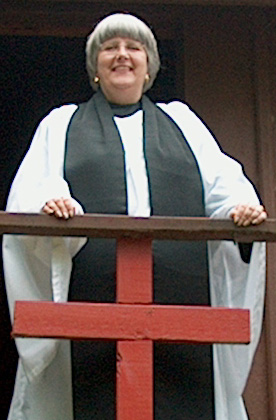
The Rev. Nancy Rosenblum was mentored by Father Carmichael and, following her ordination, served as a deacon in his parish, St. Andrew’s Episcopal Church in Albany, New York. Deacon Nancy was later the Canon Sacrist at the Episcopal Cathedral of All Saints in Albany and continues to serve parishes in the Albany area as a Deacon Assistant. She and her husband David spent many vacations at St. Hubert’s Isle as guests of the Carmichaels and are happy to continue their connection with both the Church of the Good Shepherd and the Carmichael family.
**********
1996 The Rev. George Easter, Lyon Mountain NY
1999 The Rev. Alan Macnab, Lake Placid NY
2000 The Rev. Dr. Pamela J. Lardear and the Rev. Garrie F. Stevens
Indian Lake NY and Norwood NY
Raquette Lake | William West Durant | Great Camps | Clergy | Time Line | Writings | Documents | Bibliography